
site_4bbb466c-cafd-4edb-8869-71ed8e60d33a
Excellence in PGR technology
How to Use Gibberellic Acid for Plant Growth in 2026?
Gibberellic acid can transform a weak, compact plant into one with longer stems, larger leaves, and earlier flowering. However, successful gibberellic acid and plant growth management requires more than mixing a solution and spraying it. Dose, crop variety, plant age, temperature, and application timing can change the result dramatically.
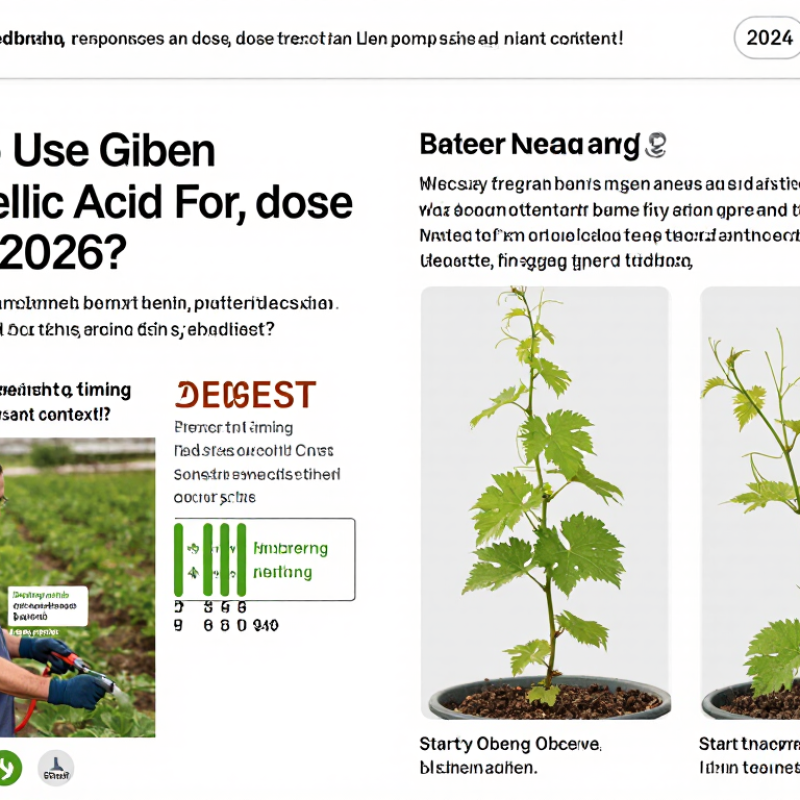
Professor Peter Hedden, a leading gibberellin researcher, has emphasized a practical principle: “Gibberellin responses depend on dose, timing, and plant context.” This idea should guide every treatment decision. A young grapevine may respond with stronger shoot extension, while a stressed seedling may become thin and unstable. More growth is not always better growth.
A careful grower begins with the product label and local agricultural requirements. Use clean water, accurate measurements, protective equipment, and a small test area. Observe the treated plants for several days. Record leaf size, stem length, flowering time, and signs of stretching. These simple notes can reveal patterns that memory misses.
The process is not perfectly predictable. Soil fertility, sunlight, and humidity may interfere. A formula that works in a greenhouse may disappoint outdoors. That is normal. Careful adjustment matters more than confidence.
This guide explains practical application methods, suitable growth stages, common mistakes, and safety-minded decisions for 2026. Its goal is balanced growth, not exaggerated height. Start conservatively. Observe closely. Then refine the treatment based on evidence.
What Gibberellic Acid Is and How It Affects Plant Growth
How to Use Gibberellic Acid for Plant Growth in 2026?
Gibberellic acid, commonly called GA3, is a plant hormone, not a fertilizer. That distinction matters. It mainly promotes cell elongation, seed germination, flowering, and fruit development. GA binds to GID1 receptors, which helps remove DELLA proteins that restrict growth. Shoots may stretch quickly, while leaves and stems become visibly longer. The response is biological, not mechanical.
More than 130 gibberellins have been identified, but only a small group shows strong biological activity, according to Hedden and Sponsel’s report in Annual Review of Plant Biology. Published horticultural trials also commonly test concentrations between 5 and 100 mg/L, depending on crop, timing, and growth stage. Lower rates may support uniform growth. Excessive rates can create weak stems, delayed flowering, pale foliage, or poorly shaped fruit.
Use the lowest tested rate for the crop. Apply during active growth, with clean water and even coverage. Avoid spraying drought-stressed plants. A small test area is essential because cultivar responses can differ sharply. This is where many schedules fail. More hormone does not mean more yield. Follow the current local product label, protective-equipment requirements, harvest interval, and permitted crop uses. Record concentration, weather, plant age, and results; one field season rarely proves a universal formula.
How to Use Gibberellic Acid for Plant Growth in 2026? - What Gibberellic Acid Is and How It Affects Plant Growth
| Data Dimension | Verified Information | Practical Use | Important Caution |
|---|---|---|---|
| What it is | Gibberellic acid, commonly abbreviated as GA3, is a naturally occurring plant hormone and plant growth regulator in the gibberellin group. | It is used to influence growth processes such as cell elongation, seed germination, flowering behavior, and fruit development. | It is not a general-purpose fertilizer and does not supply nitrogen, phosphorus, potassium, or micronutrients. |
| Primary biological action | GA3 promotes cell elongation and can stimulate cell division in responsive plant tissues. | Plants may produce longer stems, expanded leaves, and increased shoot extension after suitable treatment. | Excessive elongation can create weak, thin stems and may increase lodging or breakage. |
| Seed germination | Gibberellins can help overcome certain forms of physiological dormancy by promoting the production of enzymes that mobilize stored seed reserves. | It may be useful for selected dormant or light-sensitive seeds when the crop’s propagation guidance supports GA3 use. | It does not replace required conditions such as suitable moisture, oxygen, temperature, light, or stratification. |
| Stem and internode growth | GA3 commonly increases internode length, especially in plants that naturally respond strongly to gibberellins. | It can be used to modify plant height or promote bolting in crops where that response is desirable. | Avoid treatment when compact growth, strong stems, or delayed bolting is the production goal. |
| Flowering response | Gibberellins can promote or inhibit flowering depending on species, variety, plant age, environmental conditions, and application timing. | Use only when crop-specific research or an approved label identifies flowering as a desired response. | The same treatment can produce opposite flowering effects in different plant species. |
| Fruit development | In certain fruit crops, GA3 can affect fruit set, fruit size, elongation, firmness, or cluster structure. | Applications may be directed at flowers, fruit clusters, or developing fruit according to the crop label and growth stage. | Poorly timed or excessive applications may reduce fruit set, delay maturity, reduce color development, or lower quality. |
| Parthenocarpic fruit development | In some crops, gibberellins can contribute to seedless or low-seed fruit development without normal fertilization. | This effect is crop-specific and may be used in controlled horticultural production systems. | Results depend strongly on cultivar, dose, pollination conditions, and treatment timing. |
| Typical application methods | Common methods include foliar spraying, flower or fruit-cluster treatment, seed soaking, and localized application. | Choose the method specified for the crop, target tissue, and intended growth response. | Do not assume that a concentration suitable for seed treatment is safe or effective as a foliar spray. |
| Application concentration | Effective concentrations vary widely by species, cultivar, formulation, target tissue, and growth stage; there is no universal GA3 rate. | Follow the legally approved product label or crop-specific trial protocol rather than applying a generic internet rate. | Higher concentration does not necessarily produce better growth and can cause undesirable morphology or reproductive effects. |
| Best timing principle | Plant sensitivity changes during germination, vegetative growth, flowering, fruit set, and fruit enlargement. | Apply only at the crop stage identified for the intended response, using uniform coverage when spraying is required. | Treatment during the wrong stage may produce little benefit or negatively affect flowering, maturity, or plant structure. |
| Environmental interaction | Light, temperature, water status, nutrition, plant vigor, and day length can modify the plant’s response to gibberellins. | Use GA3 as part of a complete crop-management program rather than as a substitute for adequate irrigation, nutrition, or light. | Stressed, drought-affected, diseased, or nutritionally unbalanced plants may respond unpredictably. |
| Compatibility and mixing | Formulation pH, water quality, adjuvants, and tank-mix partners can affect product stability and plant safety. | Use clean water and mix only with materials specifically permitted by the label or supported by a compatibility test. | Avoid untested mixtures, especially with alkaline materials or other plant growth regulators. |
| Common signs of overapplication | Possible symptoms include excessive stem elongation, weak growth, abnormal plant architecture, delayed maturity, and poor fruit quality. | Stop repeated applications and review the rate, timing, coverage, plant stress level, and crop sensitivity. | Symptoms can vary by species and may be confused with low light, excess nitrogen, or other growth problems. |
| Safety and legal use | GA3 products are regulated differently by jurisdiction and may have crop-specific restrictions, pre-harvest intervals, and protective-equipment requirements. | Read the current local label, wear the specified personal protective equipment, and keep treated areas inaccessible as required. | Never use an unregistered preparation on edible crops or exceed the labeled rate and number of applications. |
| Recommended decision process | Identify the crop and cultivar, define the desired response, verify legal approval, select the labeled timing and rate, and test a small area first. | Record the formulation, concentration, application date, weather, plant stage, and observed response for future decisions. | If crop-specific guidance is unavailable, consult a qualified horticultural adviser before treatment. |
Related Posts
-
How to Use Gibberellic Acid for Seed Germination?
-

How to Source Gibberellic Acid Globally in 2026?
-
China Top Gibberellic Acid Germination Guide for Buyers
-
2026 Top Gibberellic Acid Products for Global Buyers?
-
Top 10 Gibberellic Acid Germination Tips for Global Buyers?
-
2026 Top Gibberellic Acid Label Types for Global Buyers